Saturday, 10 March 2012

Institute of Business Management Sciences - Overview
DBMS seeks to identify and remove restraints on the student’s full participation, so that individuals may explore their capabilities and interests and may develop their full intellectual and human potential to face the challenges of professional life.

To rejoice discovery and critical thought we persuade our students to respect ideas and their free expression. The rationale of our existence is to educate students who are able to restructure market place according to ever changing market conditions.

By equipping our students with state of the art training in business management and information technology is the way through which we facilitate them in attaining their career objectives. Focusing on academic and practical research, teamwork and commitment to instill the best, we achieve our objectives along with the intention to serve the society at large.

Admissions are accorded to the four-degree programmes entirely on merit basis. The success of our programmes is not only due to our highly qualified and dedicated faculty but also to the members of Faisalabad Chamber of Commerce and Industry who very graciously provide opportunity to our students at their respective organizations to complete internship requirement which is a compulsory part of their study programme. We focus on developing the personality and capability of our students through personal guidance in combination with presentations and extensive discussions in the classrooms. Above all, they are encouraged to interact with the faculty and the executives from the business, industry, banks and other financial and marketing fields.
DBMS & its Goals
We provide contemporary business education to facilitate the economy through highly skilled business professionals. We invest in building faculty resource, educational infrastructure and strong relations with all stakeholders. We unshackle students to explore, to craft and to lead. Thus we strive to become a bench mark of business education in the region.

The primary goal of the DBMS is to produce highly competent professionals by offering quality education through its academic programmes. Continuous efforts are being made to realize this goal by providing a unique learning environment in which the faculty and the students share their responsibilities for promoting the process of learning. The ingredients that are essential for creating the above mentioned learning environment are given below:
  • We believe that sustained hard work provides the underpinning for the socio-economic development of a nation. Accordingly our academic programmes have been designed for inculcating intellectual approach for creativity and resourcefulness.
  • The study programmes offered by the department develop not only the habit for working long hours but also instill the habit of applying mind for solving real life problems relating to business.
  • Our programmes are so structured that every activity enhances the student's learning power and develops his individual personality. Accordingly, the courses and the other activities of our programmes have been designed with these objectives in mind.
  • We consider character building an integral part of our programmes as learning in the absence of the desired character traits will not be of much value to an individual or to the society.
  • The system and procedures at DBMS are geared to provide support and counseling to all students based on their specific requirements. The student teacher interaction has a significant impact not only in the behavioral improvement of the students but also in the approach towards learning the concepts and in acquiring the habit of solving problem under varied situations. We provide such interaction in the form of seminar, research projects and internship.
  • The department is committed to totally merit based decisions in every aspect of its operations from selection of faculty and supporting staff to accord admission to the students to our degree programmes and evaluation of the students performance.
While keeping in mind the requirements of ever changing contemporary era due to globalization and I.T. revolution, we are continuously upgrading our curriculum/courses. We do this by keeping in mind to produce such professionals, which will be acting like change agents rather than recipient of change.
Institute of Microbiology - Objectives
VISION
In order to sustain livestock and poultry health through the technologies developed in the different sections, this Department is playing very important role in the economy of University and the Country as well.

MISSION
The Department of Veterinary Microbiology would play a key role in the forth coming WTO sanctions on all the food and Veterinary products. The research activities of this Department will provide the stairs to the industry and farmers for improving profitable production of poultry and dairy animals by the application of latest technology, skilled manpower and proper diagnostic techniques
Institute of Animal Nutrition and Feed Technology - Overview
The Institute of Animal Nutrition and Feed Technology, University of Agriculture, Faisalabad has four divisions: Ruminant Nutrition, Non-Ruminant Nutrition, Nutritional Biotechnology and Feed Technology. Research activities of Institute focus on improvement of the nutritive value of low quality feedstuffs through chemical and biological treatments; nutritional evaluation of local forages, crop residues and low grade industrial by-products; efficient and economical ration formulations for commercial poultry birds and ruminant livestock.; detoxification of naturally occurring toxins to improve the feeding value of indigenous feeds; production of single cell proteins and feed enzymes through bioconversion/fermentation; and recycling of animal wastes in the diets of small and large ruminants. Feed Microscopy courses at national level have been offered here more than six times in collaboration with American Soybean Association. Short courses on livestock feeding and poultry feeding are offered every year for the benefit of dairy and poultry farmers. This department has made noticeable contribution in imparting education and conducting problem oriented research in the field of Animal Nutrition.

The Institute of Animal Nutrition and Feed Technology has built up its capabilities to discharge its mandatory functions to teaching and research in the area of animal feed science and technology. This institute has greatly supplemented the knowledge and skill through its graduates undertaking employment in the compound feed industry. The graduates from this institute are expected to employed in feed mill at higher and middle management positions, feed analysis laboratories, research, planning and development, both in private and public sectors.
Institute of Soil & Environmental Sciences - Overview
Agriculture is the major sector of Pakistan’s economy. It contributes 25% of GDP. About 70% of population is directly or indirectly dependent on agriculture. Pakistan has 22.6 m ha of cultivated land which is about 25% of the total land area of the country. Per capita arable land in 1981 was 0.23 ha which declined to 0.16 ha. This is much below the estimated average of 0.6 ha per capita from which dietary requirement can be met with traditional agriculture. Therefore, there is no alternate but to increase the out put of existing arable land through technological innovation.

The soil is a nonrenewable natural resource and both soil and water are showing signs of degradation. Decline in productivity is corollary to this degradation. Various ailments causing soil degradation in the country include water and wind erosion, salinity, sodicity, water logging, nutrient depletion, compaction, crusting and lowering of water table under the prevailing management and ecological conditions. Soil is also an ultimate sink for various agrochemicals and industrial/urban contaminants. The concern regarding the deterioration of safe environment is growing with the passage of time and measures must be taken to safeguard the environment against the pollution. There is a dire need to safeguard the precious, nonrenewable natural resource, i.e. the soil, against degradation, enhance its productivity potential on sustainable basis while protecting the environment through development of suitable technologies and management practices.

Since, University of Agriculture, Faisalabad is a primary seat for training human resource base and research; therefore, it was imperative to strengthen various disciplines/sections in the Institute of Soil and Environmental Sciences, pertaining to soil productivity enhancement, conservation of soil and water resources from natural and human induced degradation.
Institute of Horticultural Sciences - Overview
Institute offers undergraduate and postgraduate courses in the relevant disciplines. It is equipped with the complete range of resources needed to meet the modern demands for education and research. Institute has well established Experimental Orchard, Square 9 which is among the oldest orchard established during 1912 to boost up horticultural production in the Punjab area. Today a good collection of tropical and subtropical fruit plants is maintained and research facilities on nutrition, physiology, rootstocks, unfruitfulness and production of fruits like citrus, mango, date, guava, jujuba and grapes etc. are provided. Another garden of 120 acres is also established recently at Post-graduate Agriculture Research Station (PARS) to cope with the increasing needs of student research. A germplasm bank of date palm, citrus and mango is established to provide genetic diversities for research.

Further a fully established landscape studio is established to meet the needs for advanced landscape designing techniques. Facilities for scanning, digitizing, printing and CAD software are provided. A Science and technology project entitled “Export quality cut flower production and extraction of essential oil of Rosa” is being run by institute and three Ph.D and many M.Sc. students are working on various aspects in this project. Recently a Citrus Sanitation laboratory is established in the institute to establish a modern Citrus Nursery of Certified Plants through sanitation by microbudding and micrografting techniques in vitro. Department has laboratories for graduate research where extensive range of modern apparatus is available. A well established tissue culture laboratory is there to demonstrate propagation and other operations related to all sort of plants in vitro cultures.

Under Olericulture section research is being carried out on nutritional trials in different vegetables, hybrid seed production of vegetables, effect of dates of planting and spacing on growth and yield of vegetables and Tunnel production of vegetables (Cucumber, Tomato, Chillies). A mushroom laboratory was established to facilitate the following aspects: development of spawn production technology, substrate preparation and improved method of composting for button mushroom, cultivation technology of summer white button mushroom, standardization of cultivation technology of Oyster and Chinese mushrooms and Post- harvest handling of mushrooms.

Medicinal and aromatic plants section was added in institute with the objectives: Exploration, exploitation and conservation of potential indigenous medicinal & aromatic plants, Development of production and post harvest management technology of medicinal and aromatic plants, Development of protocols for preservation of plant parts, identification/isolation of active ingredients, Providing education, training to the growers and consultancy services to the medicinal and aromatic plant industry. In addition institute has a well established Vegetable Research Area, Floriculture and landscape area for ornamental plants and a fruit plant nursery.

A new addition to the institute is a postharvest lab which has been developed with international assistance of Australian Centre for International Agri. Research and local industry. Currently, with international collaboration form Netherlands, a project on Controlled Atmosphere Technology of horticultural crops is under-way.
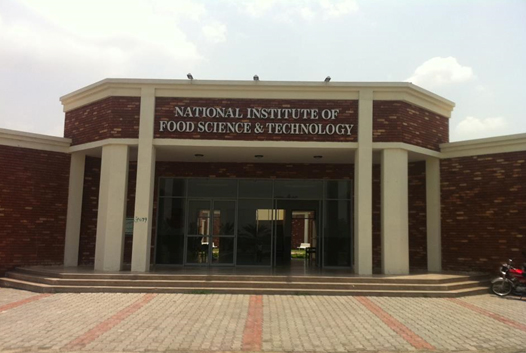
National Institute of Food Science and Technology - Overview
The National Institute of Food Science and Technology (NIFSAT) was established as Food Technology Section in the then Punjab Agricultural College and Research Institute Lyallpur in 1959-60 which was given the status of Department in 1962. The Department of Food Technology became an administrative part of the Faculty of Agricultural Engineering and Technology at the inception of West Pakistan Agricultural University, Lyallpur in 1961.

Mr. Clyde W. Eddy was the first Head of Department. Mr. Muhammad Bakhsh Bhatti, Dr. Sultan Ahmed Tremazi, Dr. Abdul Latif Rasoolpuri, Mr. Riaz-ur-Rehman, Dr. Muhammad Shafiq Chaudhry, Dr. Haji Muhammad Chaudhry, Dr. Ali Asghar, Syed Aulad Hussain Shah, Dr. Amjad Ali, Dr. Javaid Aziz Awan and Dr. Faqir Muhammad Anjum have served as Heads/Chairmen of the Department during different periods.

The scientific and technological advancements demanded the need to strengthen and upgrade the Department which could bolster the faculty and students on advanced and more technical grounds. Thus realizing the importance of the discipline in Pakistan, the Department was upgraded to Institute of Food Science and Technology in May 2003 which has further been elevated to National Institute of Food Science & Technology (NIFSAT) in June 2007. Prof. Dr. Faqir Muhammad Anjum was appointed as the founding Director General of the Institute. Today, NIFSAT at UAF is a pioneer and the only National Food Science and Technology Institute in the country. NIFSAT comprises of six sections and one center namely Grain Science & Technology, Dairy & Meat Technology, Fruits & Vegetables Technology, Oil & Sugar Technology, Food Microbiology & Biotechnology, Nutrition & Food Safety and Food Technology Transfer Centre (FTTC). The FTTC will be established with the help of Agrocampus Rennes, France.

The main thrust of NIFSAT is the application of Food Science and Technology in handling, processing and preservation of food to cope with the challenges of the rapidly growing food industry in the 21st century. There has been significant increase in the establishment of food industry during the last two decades and consequently the demand for Food Technology graduates has increased tremendously at national level and in the Gulf countries.

Presently, NIFSAT has seventeen dedicated and hardworking faculty members, who hold PhDs and MScs. Besides regular faculty, subject experts, eminent scientists and foreign professors are also working in the institute. The Institute is actively engaged in research on different aspects of Food Science & Technology including preservation, value addition, food flavoring, food microbiology, safety and nutrition. The contributions and dedication of the staff towards research is reflected through a high number of publications in the international and national journals. The dedication of the faculty members has also been recognized by various national organizations, since a number of them have won prestigious awards.

The National Institute of Food Science and Technology is improving academic and research training facilities with significant increase in number and quality of professional manpower. The laboratories of NIFSAT are well equipped with modern equipments including automatic milk analyzer, milk centrifuge machine, flame photometer, HPLC, GC-MS, electrophoresis apparatus, atomic absorption spectrophotometer, FTIR, complete microbial analysis apparatus, referactometers, viscometer, fermentor. The Institute has also established Extrusion Centre with the help of Texas A&M University, Texas, USA.

NIFSAT has recently started a separate four-years graduate degree program leading to B.Sc. (Hons.) Food Science and Technology and two-years masters program M. Sc. (Hons.) Dairy Technology. NIFSAT has strong interaction with public and private sector institutions/organizations both at national and international levels. NIFSAT has also signed various Memorandum of Understandings (MOU’s) with national and international organization/universities to strengthen Food Science and Technology discipline in the country.