.
Professional and Higher studies in Pakistan during the recent years have become very expensive. In view of the increasing expenses day by day, it is becoming very difficult for the resource poor section of the society to educate their children. Under the circumstances, financial sponsorship of deserving and merited students may help to create soothing impact on the community particularly the rural masses and bring a positive and healthy social change in the long run. True to its motto” Education with public spirit and market dynamism” the University has upgraded its existing Student Financial Aid Office (SFAO) to increase opportunities for student financial assistance and university advancement. The University has add to its organizational structure, the Offices of Student Financial Assistance, University Advancement and Career Services under the Director Student Financial Assistance and University Advancement.
Saturday, 10 March 2012
Water Management Research Centre is a strategic research and training Centre established at University of Agriculture Faisalabad. Mindful of the increasing importance of water resources in Pakistan and its contribution to the management of dwindling resources of water the project entitled “Water Management Research and Training Program for Rural Development” was initiated by the University of Agriculture Faisalabad in the Shahkot, District Shiekhupura during 1979-80 with a view to providing the needed training to the in-service staff of the On-Farm Water Management (OFWM) and Agriculture Extension services of all the four provinces of Pakistan. The project was to encompass all aspects of Water Management, to generate and adapt water conservation technologies. The contribution of Center for improving integrated water resources management within irrigation communities of project area was recognized and as a result Centre was promoted from a development project to non-development water organization: “Water Management Research Centre” during 1989. The Centre not only maintained its research impact on the farming community but also expanded its research collaborative activities from national to international level. Moreover, the Centre has been successful in developing number of water conservation technologies, running a number of national and international projects and signing MOUs with the national and international water organizations.
KEY TECHNICAL STRENGTHS - Research on crop production as affected by irrigation methods and practices.
- Design and development of water conservation technologies.
- Monitoring and evaluation of groundwater resources.
- Out reach program for the demonstration of high efficiency irrigation technologies i.e. Raised Bed Technology, drip and sprinkler irrigation.
- Stakeholder consultation, including education, training, and capacity building of Farmer’s Organizations (FOs) for the operation and management of irrigation system.
The changing role of the universities demands a greater connectivity and strong linkages with the local, national, regional and international communities. With the evolving role of the university, the Directorate of External Linkages is becoming an important office to promote national and international collaborations and to develop partnerships with public, private and non-government institutions/ organisations. This office also has the responsibility to attract international students, placement of university students and faculty in high ranking universities, facilitate interaction between faculty and industry and exert a pull for financing of training, research and development activities of the university by national and international donors, alumni, civil society and agro-based industries. Recently, activities in the directorate have extended manifolds and almost every week the university signs an MoU, agreement for collaboration and international/ national partnership agreement to facilitate teaching, research and development in the university and to bring good to lives of the farming community of the country. The university has signed about 70 MOUs with national and international organisations, including development of partnership with high ranked universities of the world for mutual exchange of staff and students and collaboration in research and development endeavours. Significantly UAF is host to projects with Australian universities (Queensland, University of Western Australia, Charles Strut University and ACIAR), JICA projects in water management, French Agro campus for Food Science and Technology, EU funded program on range management, and Pak-US Science and Technology collaborations with Texas A&M University and University of Georgia and University of California, Riverside. The University of California, Davis is also partnering up with UAF in various R&D activities including Human Resource Development. Ali Akber Group has recently entered into partnership with the UAF to combine strengths for R&D in seed and water management domains.
The directorate also coordinates with the international organisations for resource and environment conservation in their efforts to make the world a better place for the future generations.
| The University has established Students Affairs Department headed by the Principal Officer (SA), comprising of Director Students Affairs, Hall Warden, Senior Tutor and Foreign Students Advisor. The main objective of this wing is to maintain law and order situation over the campus and to provide conducive environments to the students for their studies besides provision of facilities and opportunities to take part in co-curricular, extra-curricular activities through Art and Literary Forum which includes Debating Club, Quiz Club, Society of Agricultural Writers (SAW), Art Club, Qirrat and Naat Club. The University has also established Tutorial Group System under the guidance of Senior Tutor office and to have close liaison with students. Each Tutorial Group consists of 20-25 undergraduate students. This system offers a platform to discover, enlighten and polish the hidden capabilities of the students. The students are also encouraged to initiate a positive and constructive activity that helps to improve their behavior and sharpens their intellect. The Hall Warden is overall responsible for the accommodation of students in University residential hostels. There are 17 residential halls, out of which 14 are reserved for male and three for female students. Foreign students are being looked after by a Foreign Students Advisor working under the administrative control of the Principal Officer (SA). The Foreign Students Advisor arranges their meetings, Conduct elections of International Club (I.C), guide in day-to-day activities and help in solving their problems. To give them healthy atmosphere, the Foreign Students Advisor also arranges games and honour the students with prizes. | |
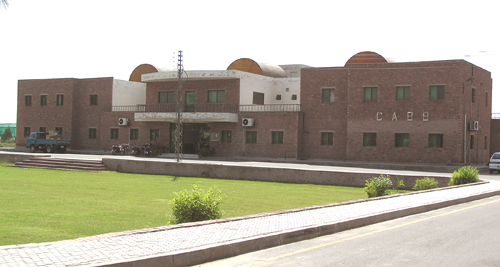
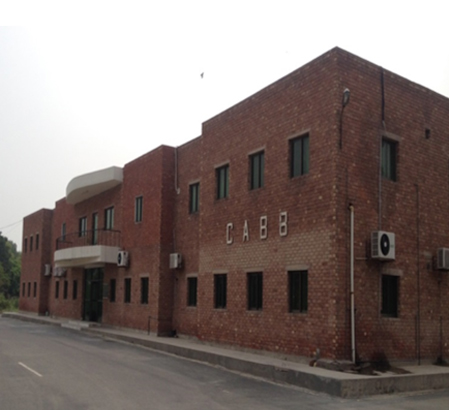
The development of the Centre of Agricultural Biochemistry and Biotechnology (CABB) at the University of Agriculture Faisalabad was approved for funding by the University Grants Commission in 1995. The establishment mandates the integration of modern knowledge and techniques of biotechnology in the conventional teaching and research systems to meet the future needs in the agricultural research and teaching.
After completion of the building the Centre was formerly inaugurated by Professor Dr. Atta-ur-Rahman, Chairman Higher Education Commission, Islamabad on 23 September 2003. A postgraduate degree, M. Sc. (Hons) Agri. Biotech. has been instituted. Two batches of the students have completed their degree and the 3rd and 4th batch are busy in their thesis research now. The admission of 5th batch is due in September 2009.
- To process approval of new/revised postgraduate courses through ASRB.
- Processing of applications for admission to M.A., M.Sc., M.Phil. and Ph.D. courses in different departments.
- Checking of enrolment forms (GS/10) of postgraduate students in each semester.
- Scrutiny of the synopses of theses, course work programmes and supervisory committees of M.A., M.Sc., M.Phil. and Ph.D. students and arranging their approval by ASRB.
- Scrutiny of the theses of postgraduate students to ensure their proper format as laid down by ASRB.
- Preparation of agenda and conduct of meetings of ASRB.
- Execution of the policies and decisions of ASRB.